Fort Myers Homes Have Their Own Set of Demands. Most Painting Crews Don’t Know Them.
There’s a version of this story that gets told about all of Florida — same climate, same construction, same paint job. Anyone who has actually worked on homes in Fort Myers knows that’s not true.
Fort Myers has a distinct set of characteristics that affect how a paint job gets scoped, what products hold up, and what a crew needs to know before they show up. Some of it is the age of the housing stock. Some of it is the waterway exposure. A lot of it is the stucco. All of it matters.
Stucco Construction Is the Baseline
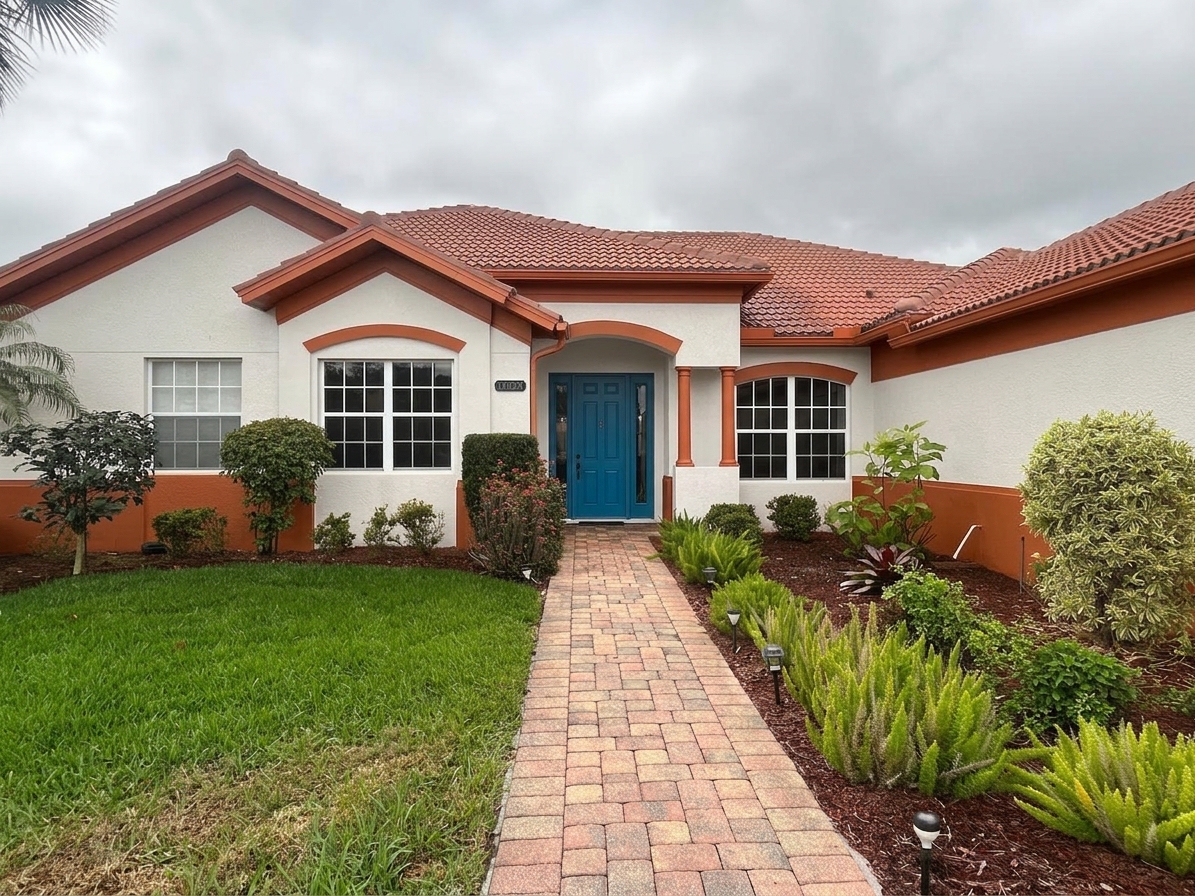
Nearly every home in Fort Myers is built on concrete block and finished with stucco. That’s not unique to the region, but the way stucco behaves here — with humidity, heat cycles, and UV exposure — creates specific demands.
Stucco is porous. It absorbs coatings differently than wood or fiber cement. It moves with temperature changes. It develops stress cracks — some visible, some hairline — and in Fort Myers those cracks cycle open and close with seasonal temperature swings.
Painting stucco correctly means selecting a product formulated for masonry: flexible enough to move, breathable enough to let moisture vapor out, and durable enough to hold up under UV without chalking out early.
Many failures on Fort Myers stucco aren’t sloppy-work failures — they’re selection failures. A crew with local experience doesn’t pick the wrong system for the substrate.
Fort Myers homes also carry a range of stucco textures — smooth, sand finish, dash, and knockdown. Each texture holds paint differently and changes coverage needs. Heavily textured surfaces can absorb significantly more paint per square foot than smooth ones. Crews that don’t account for this under-apply and wonder why the job breaks down early.
The Age of the Housing Stock
Fort Myers has been growing for decades, so the housing stock spans a wide range of ages and construction standards. Older neighborhoods like McGregor, Page Field, and Villas include homes built in the 1950s, 60s, and 70s — with different materials, different methods, and different paint histories than newer development.
An older home has likely been painted multiple times. Some layers were applied correctly. Some weren’t. Some used oil-based products that can be incompatible with modern latex coatings. Some surfaces have been patched and painted over enough times that the wall has a complicated history.
Prep on an older Fort Myers home is a different job than prep on a five-year-old build. It requires more assessment and more testing of what’s on the surface before deciding what goes on top.
Newer construction along Daniels Parkway, Colonial Boulevard, and toward Estero is different: builder-grade paint is common. It covers, but it isn’t designed for longevity. First-time repaints on newer homes often require better priming and higher-performance products than the builder used.
Heat and UV Exposure
Fort Myers gets more days of direct sun per year than most of the country. The UV load fades color, chalks surfaces, and degrades paint film between cycles.
South and west-facing walls take the hardest hit. A south-facing wall can look noticeably more worn than a north-facing wall within a few years — even with the same paint applied the same day. That’s physics.
What separates a job that holds up from one that ages unevenly is product selection (UV resistance) and application (proper film thickness).
Premium exterior products formulated for high-UV environments aren’t a luxury in Fort Myers. They’re baseline for durability.
Humidity and the Rainy Season
Fort Myers averages roughly 55 inches of rain per year, concentrated during the summer rainy season. That moisture affects paint in ways that aren’t always obvious.
Humidity slows dry time and changes cure behavior. Painting at the wrong time of day or in the wrong conditions leads to poor adhesion, extended cure times, and surfaces that are more vulnerable to mildew after application.
Professional crews work around conditions: early starts, avoiding peak humidity windows, and monitoring forecasts and surface dry-down instead of forcing a schedule.
Mildew and Algae
Walk through almost any Fort Myers neighborhood and look at shaded walls and north-facing elevations on homes that haven’t been painted recently. Dark streaking is often mildew and algae — a natural result of warmth, humidity, and shade.
Left unaddressed, growth compromises adhesion and continues under the new finish. Painting over it without treatment is one of the most common reasons paint fails faster than it should.
Proper treatment means cleaning with an appropriate solution before prep begins and selecting a finish product with built-in mildewcide for surfaces prone to regrowth. Both matter. Neither is optional in Fort Myers.
What This Means for Your Paint Job
Stucco texture, home age, UV exposure, rainy-season humidity, and mildew pressure all affect how a paint job should be scoped, what products should go on the walls, and how a crew should approach the work.
A company that operates in Fort Myers without understanding these specifics will still paint the home — it just won’t hold up the way it should. And in this climate, early failure isn’t only cosmetic. It’s maintenance that compounds.
Rollur was built by people who have been running painting crews in Fort Myers and surrounding areas long enough to understand these specifics from the inside. Every crew on the platform is vetted for local knowledge and local standards.
When you get an estimate through Rollur, the scope accounts for what your home actually needs. Products are selected for this climate. The crew that shows up has done this work here before.
Get Your Instant Estimate